How Our Hailstorm Prediction Algorithm Works

Understanding the ConvectAlert HailNow hailstorm detection system

Hailstone in hand showing the size and structure of hailstones

Hailstorms are an extremely costly natural disaster in Canada, occurring mainly during the spring and summer months when weather conditions allow for the development of powerful thunderstorms. These thunderstorms in turn form hailstones, which are dense balls of ice that fall to the ground, often causing significant property damage. Alberta is known as the hail capital of Canada, experiencing by far the most hailstorms, however there are currently a lack of resources being dedicated to the prediction, detection, and mitigation of the damage caused by hailstorms.

ConvectAlert Analytics was created to bring better weather data to Canadians. By bridging the gap between the information that skilled meteorologists have access to, and the general public, ConvectAlert brings actionable weather data to Canadian businesses in a way that you don't have to be an atmospheric scientist to understand.

The objective of this demo is to show how ConvectAlert's HailNow Alert Service works. The service is just one of the ways ConvectAlert aims to reduce severe weather damage for businesses, however it's fundamental to providing advance warning of incoming hailstorms, allowing businesses to activate severe weather plans and reduce preventable hail damage.
Background

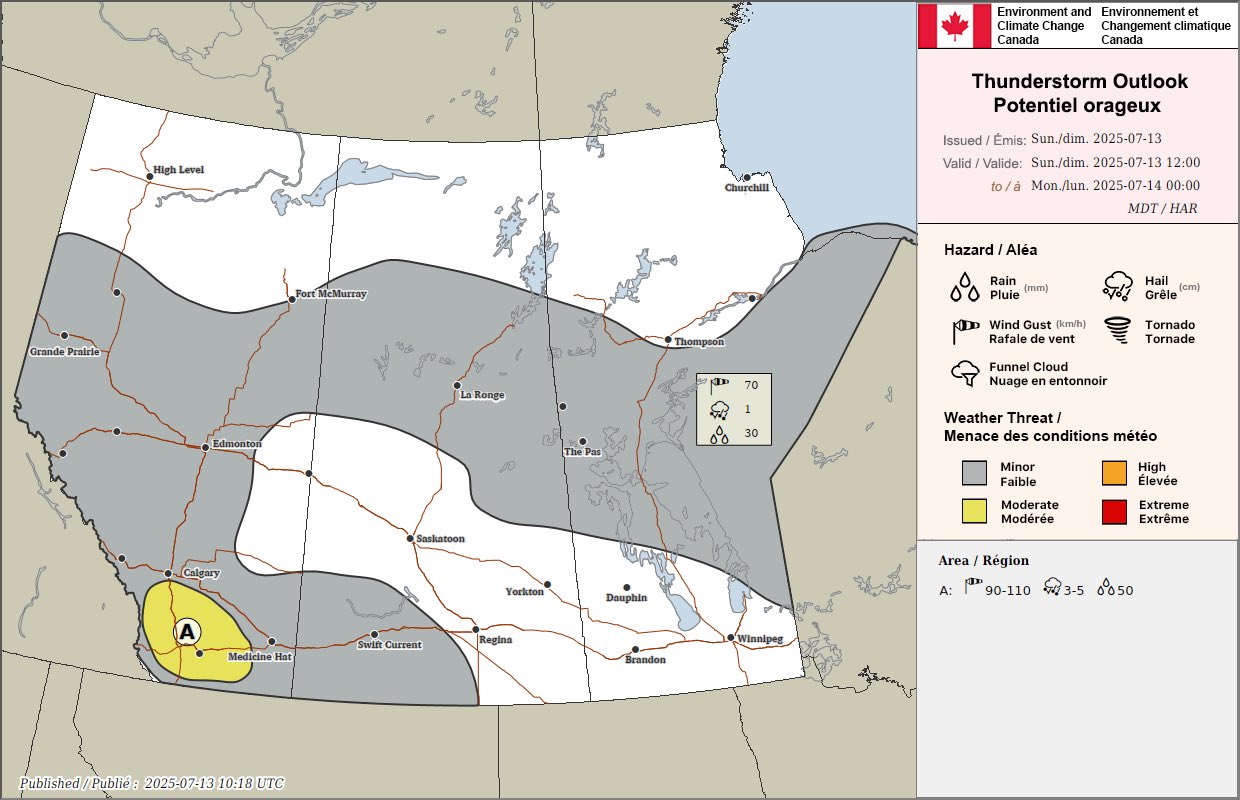
July 13, 2025 was a typical summer day in Southern Alberta, with warm and humid conditions, leading weather forecasters to anticipate a risk for severe thunderstorms roughly from Calgary down towards the Montana border, as is shown in the map above. While it wasn't predicted to be an especially dangerous day for thunderstorms, weather models were in very good agreement about severe thunderstorms occurring somewhere within the Calgary-Lethbridge corridor. In addition to this, weather models such as the HRDPS were consistently calling for a severe thunderstorm to pass directly through Calgary in the evening hours.

ECCC weather map for July 13, 2025
Environment and Climate Change Canada severe weather outlook map showing the anticipated severe weather on July 13, 2025.

July 13 Progression

Around noon on July 13th, a severe thunderstorm watch was issued for Calgary, with tornado watches being issued to the south of the city. This was the first real storm risk communicated to the general public, however with it being the third severe thunderstorm issued for Calgary up to that point in the 2025 storm season, it wasn't cause for alarm yet.

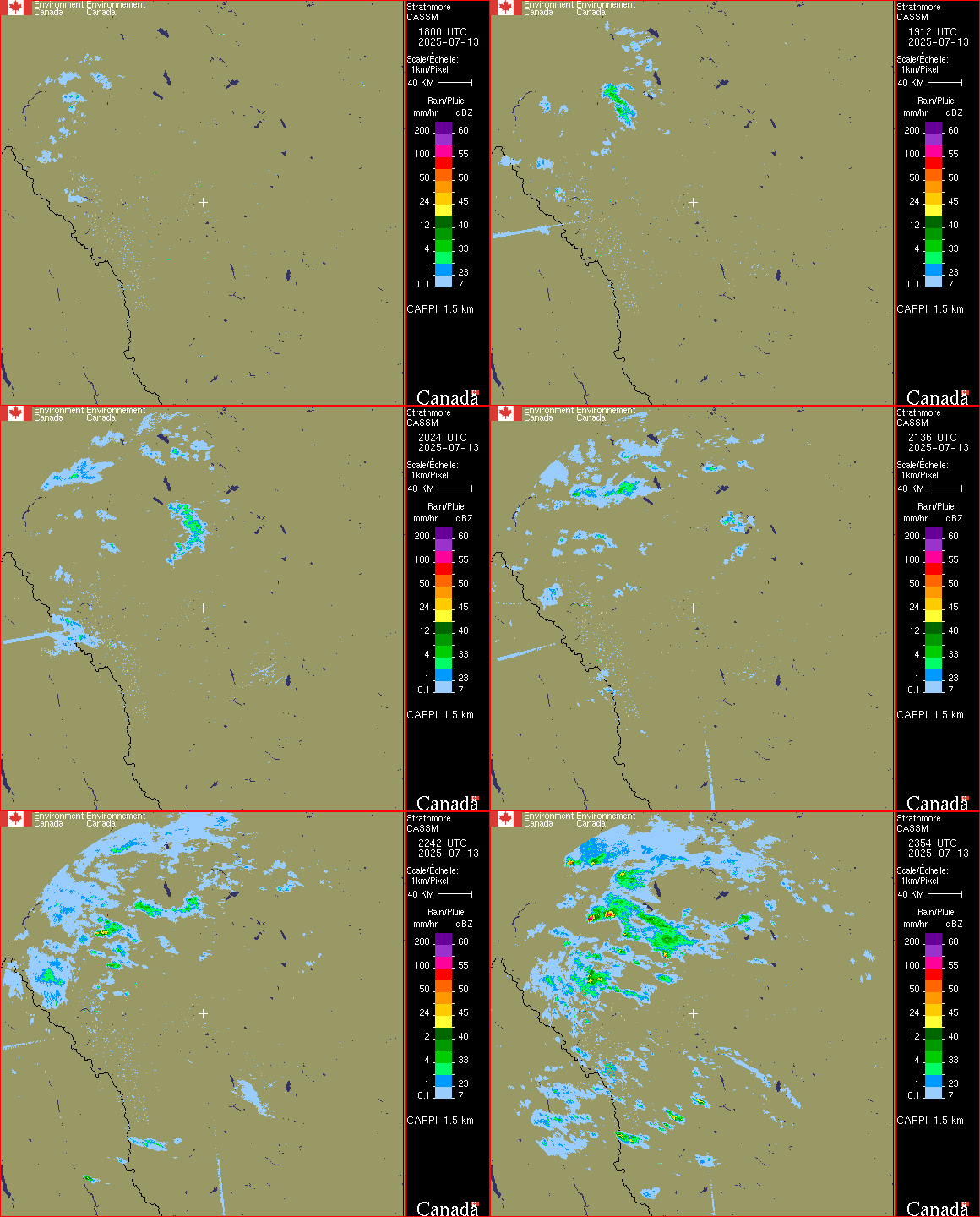
Very little occurred throughout the day until around 5pm, when scattered showers formed to the northwest of the city. These showers would gradually intensify until just after 6pm, when the severe thunderstorm that would go on to hit Calgary first formed near Waiparous.

CASSM radar progression for July 13 up until storm initiation time
Radar data from the Strathmore weather radar between 12pm and 6pm. Scattered showers (shown in blue & green) can be seen approaching Calgary from the NW towards the end of the gif.

Given the modelled weather conditions on July 13th, any storm forming near Waiparous (NW of Calgary) should've been a significant cause for concern as its track would take it right through Calgary. This became increasingly clear around 6:30pm when the storm intensified significantly and began tracking right towards Calgary.

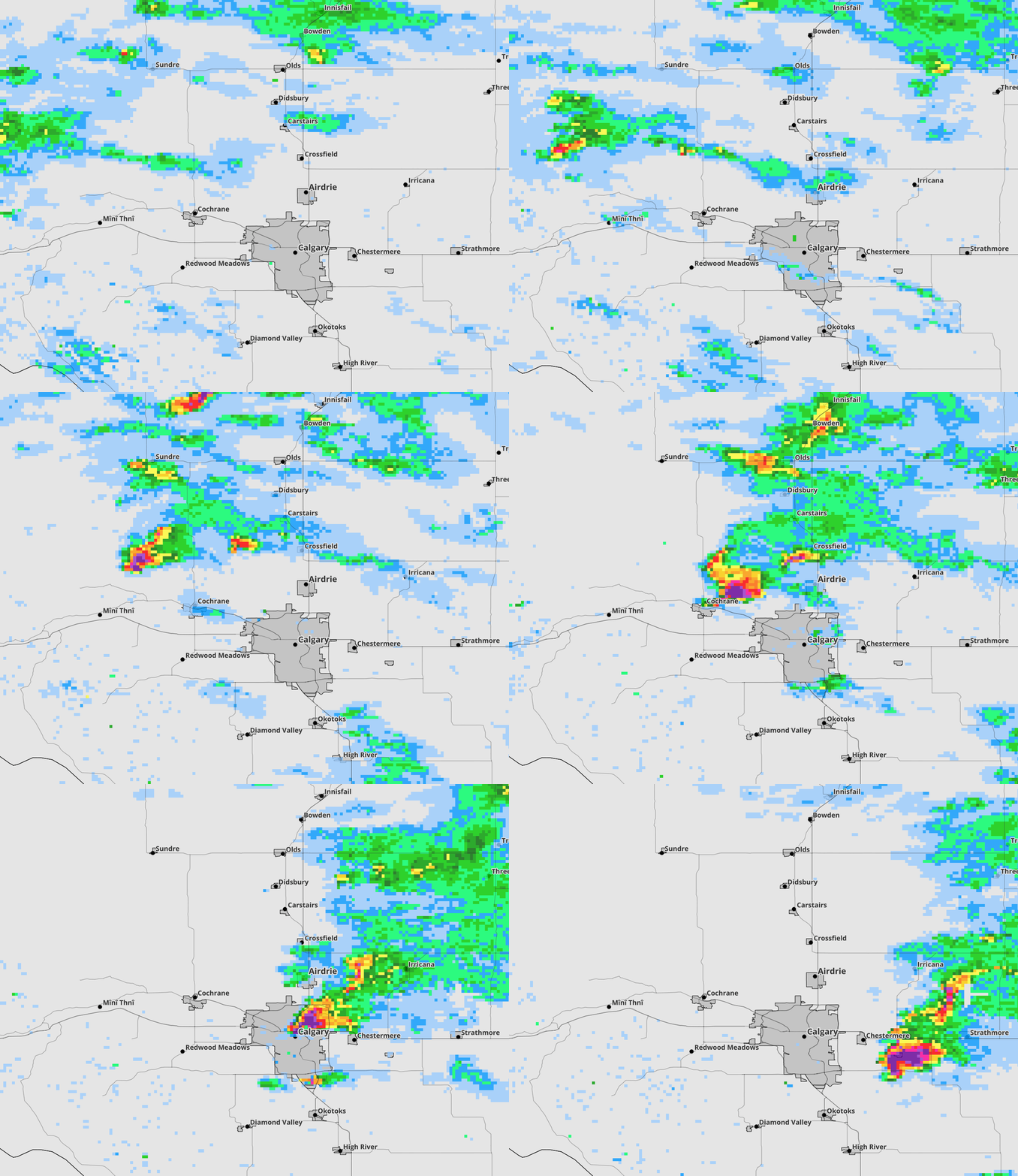
Radar progression map for July 13 storm
This animated sequence shows radar frames from when the storm initiated through its passage over Calgary, displaying weather radar data. The pink and purple pixels are where hail likely occurred.

ConvectAlert HailNow Alert Service

Our alert service operates by continuously monitoring real-time radar data and applying our detection algorithm to identify storms that meet specific criteria for hail production potential. When a storm is detected that exceeds our predefined thresholds for creating alert polygons, the system begins tracking the storm's movement and characteristics. The system issues actual alerts when the storm's intensity and predicted path indicate a high probability of significant hail impact on protected areas, allowing businesses and property owners to take protective action with sufficient lead time.

The triggering thresholds for creating polygons are based on a combination of radar reflectivity values, storm structure indicators, and environmental parameters that suggest the storm is capable of producing hail. For actually issuing alerts, the system requires that the storm not only meets the polygon creation criteria but also shows sustained intensity and a predicted path that intersects with areas of interest, ensuring that alerts are only sent when there is a genuine threat.

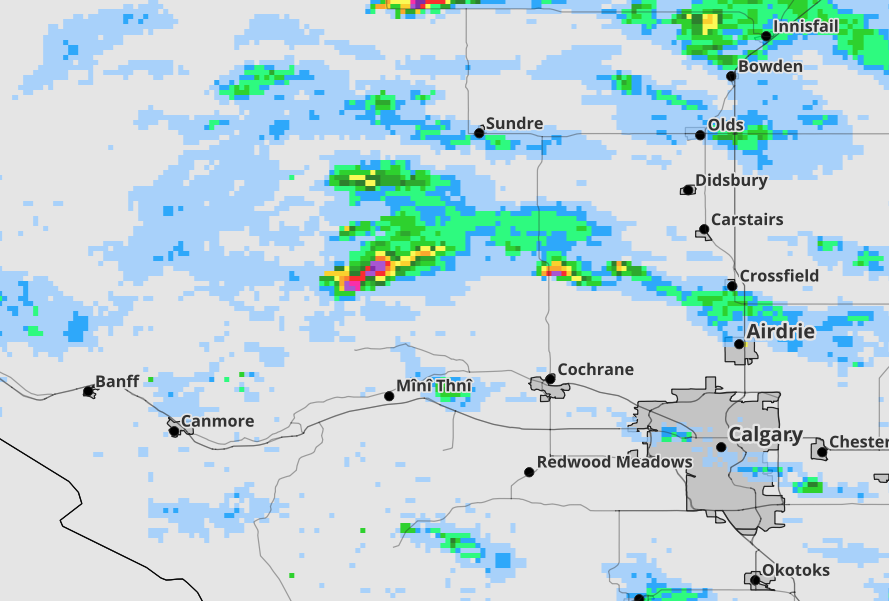
Early storm progression radar frame
This radar frame shows the early stages of the storm that hit Calgary as it began to intensify. No alert has been issued yet as the storm is too new, and therefore highly unpredictable. Thunderstorms often change the direction in which they're moving as they intensify, so issuing alerts as soon as storms form is not ideal.
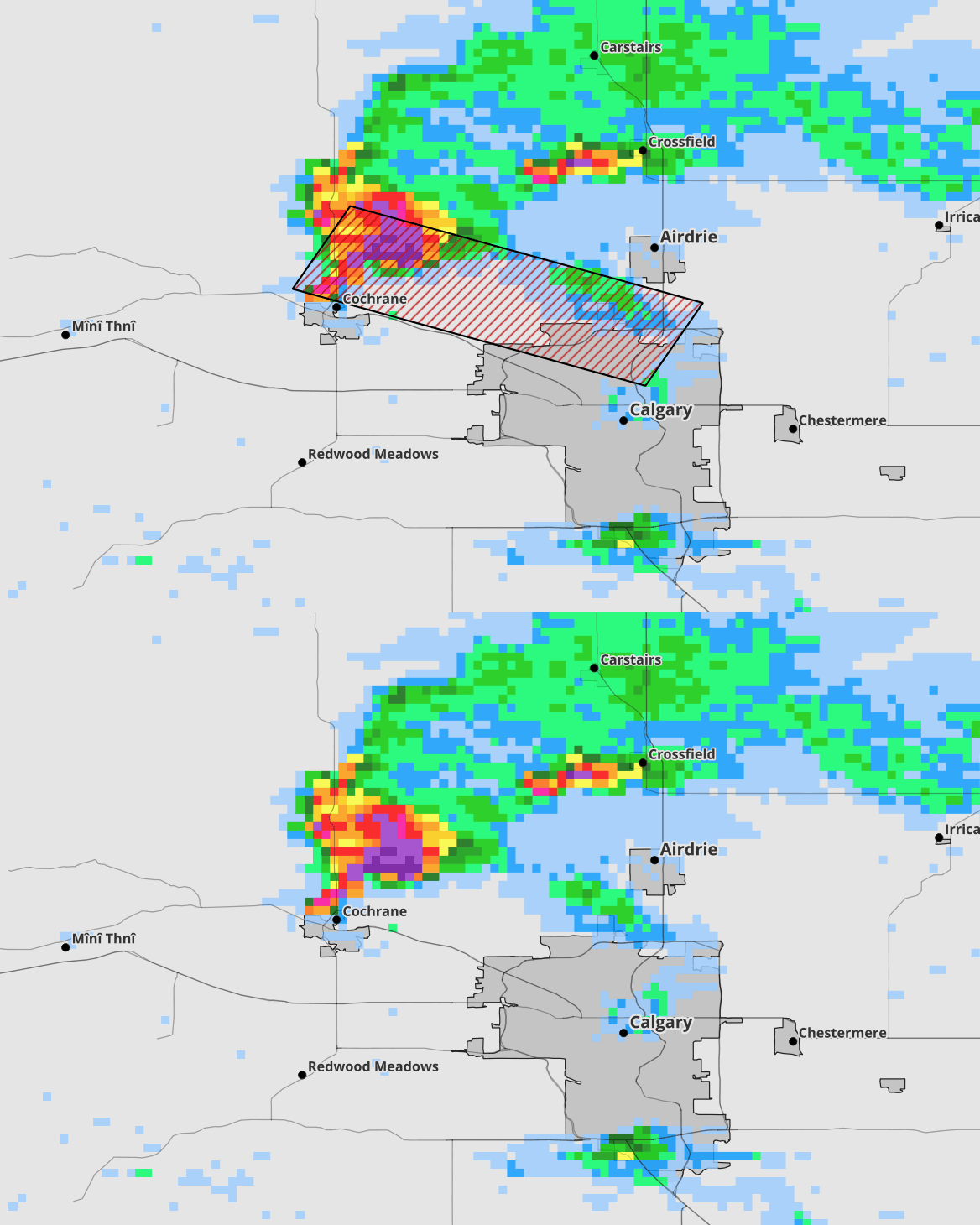
Mid stages of storm development (N/NNE of Cochrane) with alert polygon
Weather radar data from 7:18pm showing the predicted storm path tracking into North Calgary based on the storm's movement.

The above gif shows the weather radar and alert polygon from 7:18pm as the thunderstorm was passing just north of Cochrane. The predicted path of the storm shown is derived from our proprietary ConvectAlert algorithm, which analyzes the storm's previous movement, size, and intensity in order to predict where it'll track in the future. This algorithm is used to determine the area that's most likely to be impacted by the hailstorm in the near future.

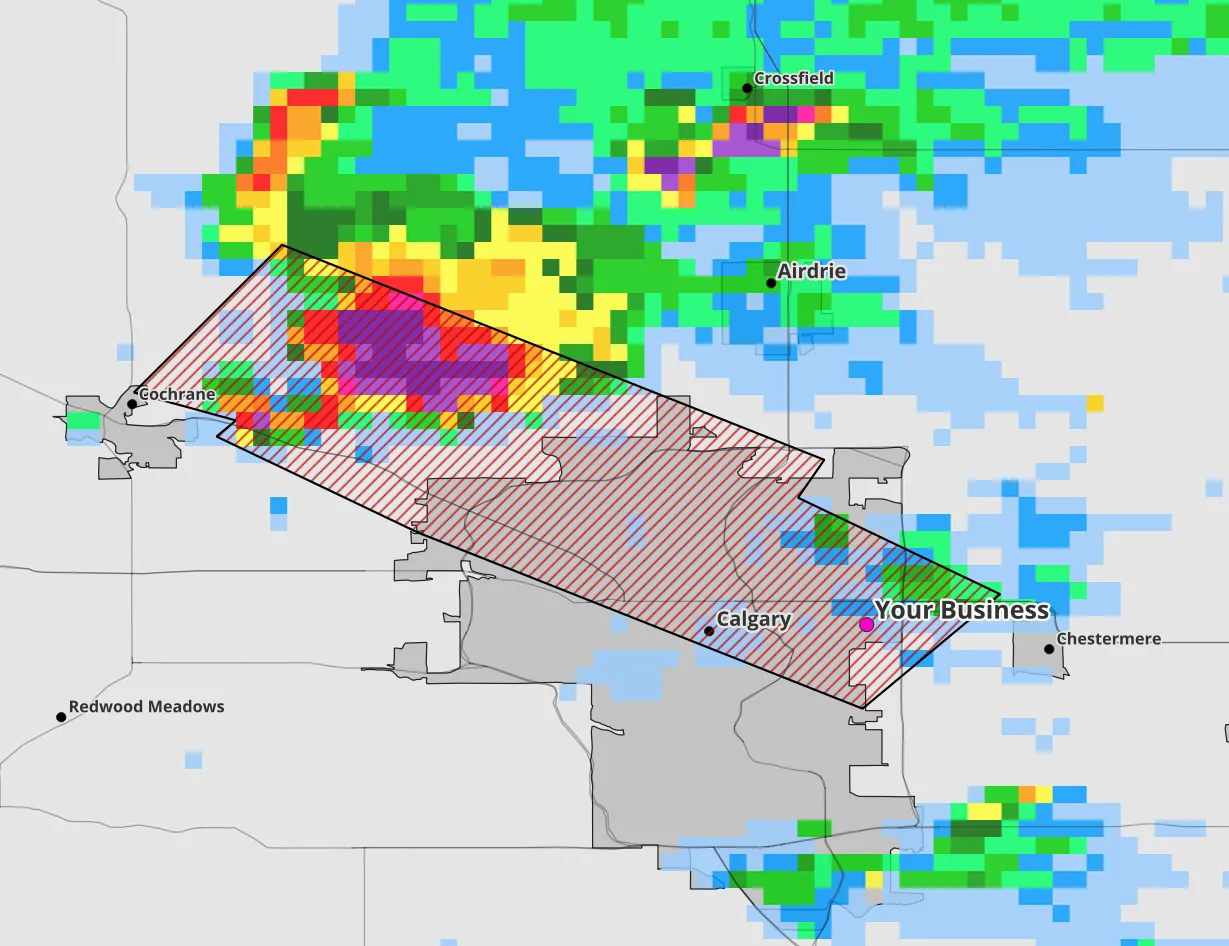
Prime example of alert issuance with business location marked
Radar and alert service data showing the active alert areas over Calgary combined with radar at 7:30pm.

This image shows the radar data combined with the alert service's active alerts over the city of Calgary at 7:30pm. The areas highlighted on the map are where the algorithm has identified a high probability of damaging hail occurring in the next 30 minutes.

Let's assume you have a business at the location shown on the map in East Calgary. Based on a 30 minute lead time, you'd first receive a hailstorm alert at 7:30pm upon entering the warning area. Being within the warning area in this case would mean that your business would be at imminent risk of being hit by a hailstorm within the next 30 minutes.

Upon learning this information, your business may decide to implement its severe weather management plan, and do things such as cover vehicles with protective covers, move equipment indoors, or move customers & staff indoors for protection.

Text Message Alerts

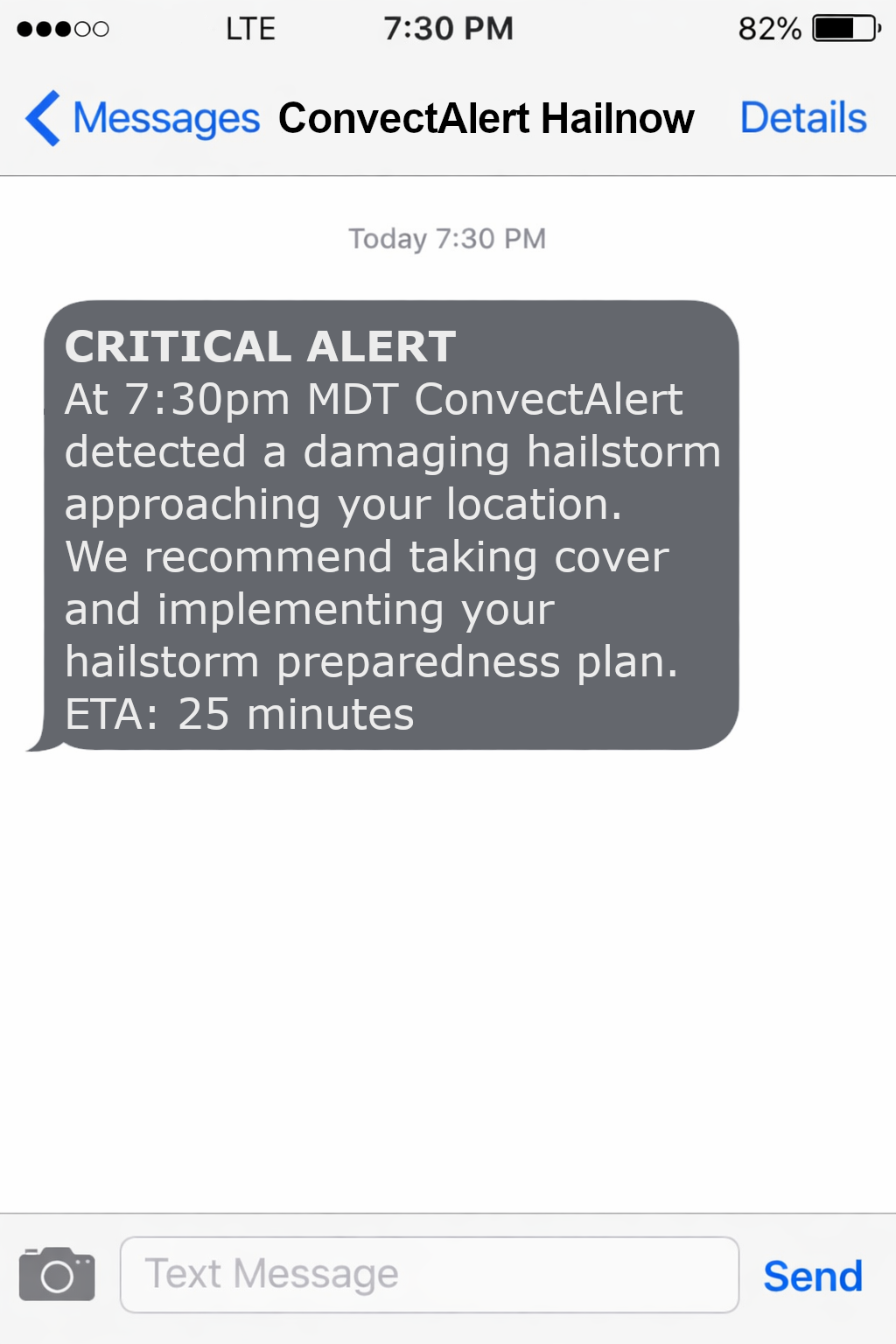
Text message alert about approaching hailstorm on phone
Example of a text message someone within the warning area shown above may receive from ConvectAlert.

In order to get as far as sending you weather alert, ConvectAlert does a significant amount of analysis on the weather data to ensure the alert is justified. Criteria such as the storm intensity, size, movement and age are all considered when determining whether it's likely that any given area will be impacted by a hailstorm. A text alert will only be sent out to customers when ConvectAlert deems there to be a significant risk of the customer's immediate area being impacted by a hailstorm, typically within the next hour.

Unlike many traditional solutions, the detection and issuing of our alerts does not require human intervention, meaning alerts can be issued within seconds of hailstorm detection, providing customers with a longer window to take action.

ConvectAlert HailNow alerts are intended to help businesses make informed decisions about when to take protective action against hailstorms, such as by covering or moving assets, shifting operations, or invoking severe weather action plans.

It's important to note that our alerts do not serve as a replacement or substitute to official weather alerts, such as those from Environment and Climate Change Canada (ECCC), but rather we operate a premium "heads up" service that's intended to notify businesses of approaching severe weather so that they can activate their own internal severe weather protocols.

Due to the unpredictable nature of the weather, our service will never be 100% accurate in predicting the future, however we strive to deliver alerts that are of high enough accuracy to be worth taking action over. It's also worth noting that predicted storm tracks, and especially the ETA predictions should be taken with a grain of salt, as they can only be as accurate as the granular datasets they're built off, which often have resolutions measured in kilometres.

HailNow Alert Service Applications

  • Car dealerships: Dealerships using the HailNow alerting system can use the advance notice to deploy temporary car covers to protect vehicles from hail damage.
  • Aviation businesses: Aircraft operators can stow, cover, or move aircraft from at-risk areas.
  • Outdoor events: Earlier warning of approaching storms allows event organizers to activate thunderstorm protocols sooner, allowing for safer and more timely action to protect attendees and equipment.
  • Construction companies: Activities like concrete pours can be postponed well in advance of approaching storms, additionally hail-sensitive equipment and materials can be moved to reduce hail damages.

Higher-quality weather alerts has many applications across many industries which suffer impacts from severe weather. In many cases simply having 15 extra minutes of advance warning can have a significant impact on the types and degree of action that can be taken to reduce hail damage, or prevent it altogether.

Our HailNow Alert Service takes a new approach to weather alerts, providing more accurate, precise and timely notifications than traditional weather providers. Rather than making guesses based off vague, imprecise publicly available weather forecasts, ConvectAlert provides businesses with professional and actionable weather information, without being overly technical.

HailNow alerts can be tailored for different levels of protection and business needs, whether that's critical alerts only, or alerts days in advance of severe weather potential, or both. We recommend the highest level of protection for businesses such as car dealerships or aircraft operators which may suffer costs well into the 6 figures if impacted by a hailstorm. Lower levels of protection may be suitable for businesses willing to take more risk, or those requiring only basic levels of protection.

Conclusion

Picture of a hailstone

Hailstorms pose a significant threat to businesses as they can cause a significant amount of property damage and operational disruptions, often with very little advance warning. Existing weather solutions fail to provide businesses with specific, accurate, and timely enough weather information to take action and reduce hail damages.

ConvectAlert's HailNow Alert Service takes a new approach to hailstorm prediction by using real-time weather radar data to specifically track and predict the movement of hailstorms as soon as they occur. Our alert service provides businesses with severe weather warnings that can be tailored to your specific business location and desired level of information. By using our service, businesses will receive actionable weather information, greater lead times, and only receive alerts actually relevant to their exact location.

The services provided by ConvectAlert go above and beyond what's currently available for businesses, applying specialized technology and expertise specifically tailored for the prediction of hailstorms. The HailNow Alert Service advances ConvectAlert's goal of bringing better weather data to Canadians by providing actionable weather information that goes above and beyond what's currently available, while also not requiring advanced meteorological knowledge to understand.

Ready to protect your business?

Learn more about how ConvectAlert Analytics can provide customized hailstorm alerts for your operations.